Influence of ENSO on the Coastal Upwelling along Northwest Africa
1.Seminar presentation
This article was presented as part of a series of seminars chaired by scientists from Climatematch Academy’s collaborating organizations, CMIP (Couple Model Intercomparison Project) and LEAP (Learning the Earth with Artificial Intelligence and Physics).
2.Introduction
The Earth’s climate system is characterized by phenomena impacting both the atmosphere and oceans, such as the El Niño-Southern Oscillation (ENSO), which significantly influences global weather and oceanic processes through teleconnections (BJERKNES (1969)). The Pacific-North Atlantic (PNA) teleconnection links ENSO to the climate in the North Atlantic (Müller et al. (2008)), which is sensitive to the peak El Niño positive sea surface temperature (SST) anomalies appear in the Eastern Pacific (canonical El Niño) or the Central Pacific (Modoki El Niño) (Palipane et al. (2013); Taschetto et al. (2015)). While ENSO’s broader effects are extensively studied, local phenomena like coastal upwelling systems are poorly understood.
Coastal upwelling, typically driven by local alongshore wind stress (AWS), acts as the primary nutrient-transport mechanism from the deeper ocean to the near-surface euphotic layer and regulates upper ocean thermal conditions and nutrient supply, which sustain phytoplankton that forms the base of the marine food web (Kämpf & Chapman (2016)). In the present analysis, we focus on the southern part of the Canary current upwelling system spanning the coast of Northwest Africa (Panel A), where SST are projected to rise 2.5 - 4 °C over the next 75 years (Varela et al. (2022)). Coastal upwelling may potentially limit this warming to the lower value of 2.5 °C, thereby limiting the associated risks. These temperature changes pose ecological and economic consequences, impacting pelagic fish size and productivity (Gregory et al. (2019)), thereby influencing regional food security and economic sustainability (related to UN Ocean Decade outcome 3: A Productive Ocean, supporting sustainable food supply and sustainable ocean economy https://
Teleconnection effects between the ENSO and the Atlantic remain comparatively poorly understood (Pérez‐Ramírez (2017)), particularly since the diversity of El-Niño events was identified. Therefore, the present research addresses the question “How coastal upwelling along the Northeast Atlantic Ocean is controlled by canonical and Modoki type El-Niño events through teleconnections?”
3.Data and Methods
To understand the PNA teleconnection, high-resolution daily SST datasets (CMEMS OSTIA SST, with a grid spacing of 0.05°) covering the period from 1982 to 2014 were used to carry out two sets of analyses. The methods implemented for these two analyses are outlined in Figure S1 (Panel G).
The first method identifies linked modes that are difficult to justify physically. Discussions corresponding to this analysis are presented in the supplementary materials section. In the second set of analysis, the Pacific SST data was first filtered using a principal component analysis (PCA) to identify the Eastern and Central Pacific Modes of SST variation following Takahashi et al. (2011). Then, a canonical correlation analysis (CCA) was carried out between each of the modes identified previously (Eastern and Central Pacific Modes) and the unfiltered Atlantic SST. While maximum covariance analysis (MCA), used in the previous set of analyses, seeks to maximize the spatial cross-covariance explained by the leading modes, CCA maximizes the temporal cross-covariance between the two modes (Navarra & Simoncini (2009)). CCAs have been used to identify ENSO-linked variations by Zhang et al. (2020).
The SST-based coastal upwelling index (UISST) computed as the cross-shore SST difference was used to quantify the upwelling response. It is computed as the difference in SST between each coastal point and a corresponding offshore point at the same latitude but 5 degrees of longitude to the West. This index turns negative as cold waters reach the surface near the coast during active coastal upwelling. It is seen in Panel B that active coastal upwelling is observed perennially in the northern part of the coast, while a pronounced seasonal cycle is observed in the southern part. Thus, the northern part of this coast is identified as a perennial coastal upwelling system, while the southern part is identified as a seasonal one. Further, the NINO3 and IEMI indices were used as indicators of canonical and Modoki El Niño events following Li et al. (2010).
4.Results and Discussions
One unique pattern of Atlantic SST variations associated with each of the two ENSO modes (Eastern and Central Pacific warming) is identified through the CCA. However, to identify a unique linked component, it is necessary to identify the optimal lag value. The method followed to identify the lag is described in subsection 3.1. Like PCA, CCA also separates the spatial and temporal variabilities of the given data field. We examine the Atlantic SST spatial variation linked to the Eastern and Central Pacific El Niño modes in subsection 3.2. Finally, in section 3.3, we explore potential mechanisms that may explain this linked variability.
4.1.Identification of Optimal Lag through CCA
Unlike the complex MCA, there is no systematic method of handling lagged modes in the case of CCA. Hence, the CCA was repeated for lags of 1 - 6 months. A maximum of explained covariance and correlation coefficient is observed among the first CCA modes for responding to each lag value. The lag value corresponding to that maximum is identified as the optimal lag. For the Eastern Pacific (or canonical) El Niño mode, the maximum correlation coefficient between Atlantic and Pacific CCA modes (r=0.8759; p<0.001) is observed at a lag of 4 months. Hence, the first Atlantic CCA mode at this lag value is selected as the Atlantic SST variation that is optimally linked to canonical El Niño SST signatures. Similarly, for the Central Pacific SST variation (or the Modoki El Niño mode,) the maximum correlation coefficient (r=0.5561; p=<0.001) occurs at a lag of 3 months. The corresponding first Atlantic CCA mode is identified as the variation optimally linked to Central Pacific (or Modoki) El Niño signatures.
4.2.SST variation linked to canonical and Modoki El Niño
The Atlantic SST variation linked to canonical (Eastern Pacific) El Niño events is presented in Panel E. In this case, the variation over most of the basin remained moderately positive (warmer temperatures) with relatively cooler temperatures of the Western Sahara with a particularly broad cold tongue around the Cape Blanc. Mildly cooler waters are observed along the remaining section of the coast. Thus, the Atlantic coastal SST variations linked to the Modoki El Niño suggest enhanced coastal upwelling along the northern section.
The Atlantic SST variation linked to the Modoki (Central Pacific) El Niño (illustrated in Panel D) consists of weakly negative values through most of the basin, with strong coastal variations. Positive variations are observed along the northern section of the coast of Western Sahara (extending south till the Cape Blanc). Strongly negative coastal variations are observed along the remaining portion of the coast (particularly from the Cape Blanc to Cape Verde). The presence of cold waters along the coast indicates active coastal upwelling events. Thus, the positive temperature variations observed along the northern section of the coast demonstrate a suppression of coastal upwelling. Suppression in coastal upwelling linked to positive ENSO phases has been observed previously (Roy & Reason (2001)). López-Parages et al. (2020) observed a similar ENSO-linked variation of round sardinella biomass off the Western Sahara using a physical-biogeochemical model.
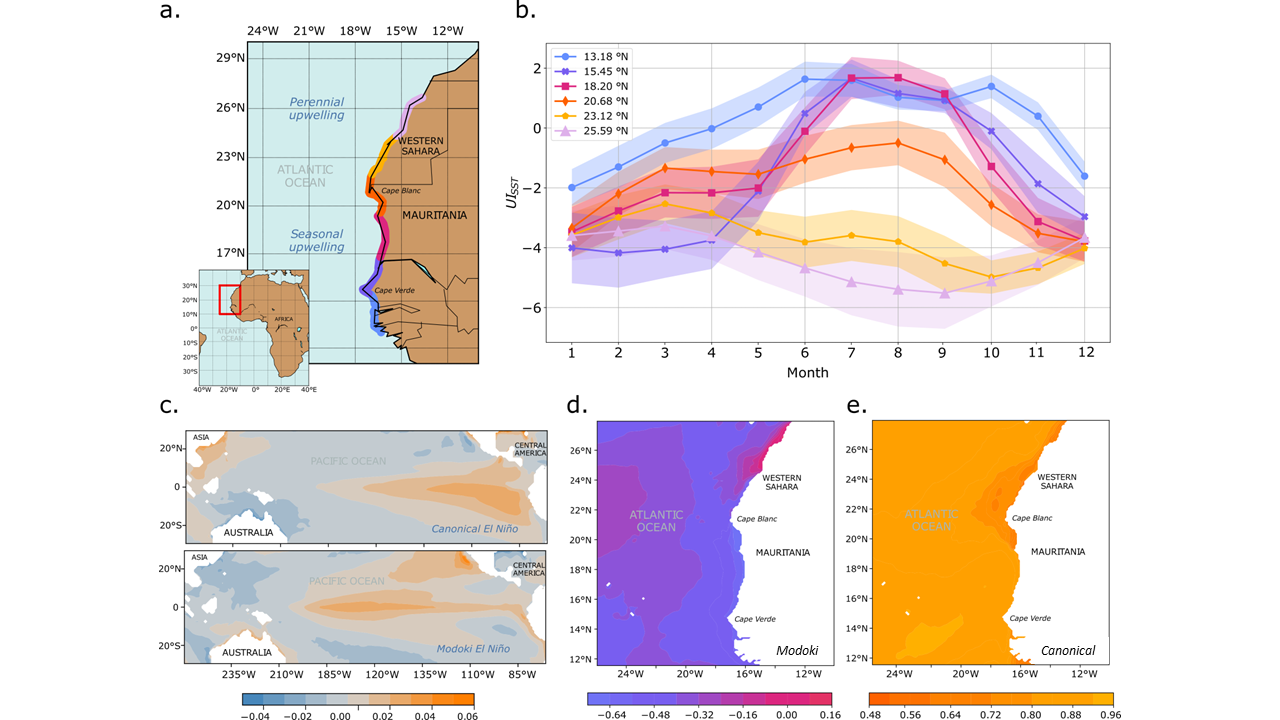
Figure 2.:Main figure showing: (A) Map of the study region along Northwest Africa coast; (B) Coastal upwelling index (UISST) showing seasonal and perennial upwelling patterns; (C) NINO3 index indicating canonical El Niño events; (D) Atlantic SST variation linked to Modoki (Central Pacific) El Niño showing coastal warming in the north and cooling in the south; (E) Atlantic SST variation linked to canonical (Eastern Pacific) El Niño showing broad cooling along the Western Sahara coast; (F) IEMI index indicating Modoki El Niño events; (G) Flowchart of analysis methods including MCA and CCA approaches.
4.3.Potential Mechanisms
Although a full analysis of the driving mechanism falls outside the scope of this analysis, in this section, we explore the potential mechanisms linking the Central Pacific SSTs to coastal SSTs in the Northeastern tropical Atlantic based on literature. The “moderately positive” values observed over most of the basin in the canonical-linked mode might be associated with warming which has been attributed to reduced trade winds (Amaya & Foltz (2014)). Amaya & Foltz (2014) observed that a stronger PNA teleconnection and atmospheric Kelvin waves result in significantly weaker trade winds during canonical events. The suppressed trade winds in turn reduce heat flux and thereby raise temperatures. Amaya & Foltz (2014) also observed no warming during Modoki events and observed cooling in the Northeastern tropical Atlantic, this is also observed in Panel D of our analysis.
Our analysis reveals that in addition to the warming (cooling) observed broadly all over the basin during canonical (Modoki) events, significant coastal SST variations also occur. During the canonical event, relatively cooler waters are observed off the Western Sahara. As the intensity of coastal upwelling is driven by the alongshore wind component, it is a function of both wind speed and direction. This might indicate that the disrupted trade winds, though, weak, are potentially better aligned with the coast, allowing more intense coastal upwelling. This coastal upwelling in turn limits the warming along the coast. Similarly, significantly warmer coastal SSTs are observed along the northern section of the coast during Modoki events, indicating a possibly poorer alignment of winds with the coast.
The following are some limitations of this analysis:
The effect of other interannual variations (such as the North Atlantic Oscillation) was not considered here.
The suggested mechanisms were not verified using wind data.
- BJERKNES, J. (1969). ATMOSPHERIC TELECONNECTIONS FROM THE EQUATORIAL PACIFIC1. Monthly Weather Review, 97(3), 163–172. https://doi.org/10.1175/1520-0493(1969)097<;0163:atftep>2.3.co;2
- Müller, W. A., Frankignoul, C., & Chouaib, N. (2008). Observed decadal tropical Pacific–North Atlantic teleconnections. Geophysical Research Letters, 35(24). 10.1029/2008gl035901
- Palipane, E., Lu, J., Chen, G., & Kinter, J. L. (2013). Improved annular mode variability in a global atmospheric general circulation model with 16 km horizontal resolution. Geophysical Research Letters, 40(18), 4893–4899. 10.1002/grl.50649
- Taschetto, A. S., Rodrigues, R. R., Meehl, G. A., McGregor, S., & England, M. H. (2015). How sensitive are the Pacific–tropical North Atlantic teleconnections to the position and intensity of El Niño-related warming? Climate Dynamics, 46(5–6), 1841–1860. 10.1007/s00382-015-2679-x
- Kämpf, J., & Chapman, P. (2016). Upwelling Systems of the World. Springer International Publishing. 10.1007/978-3-319-42524-5
- Varela, R., Rodríguez-Díaz, L., de Castro, M., & Gómez-Gesteira, M. (2022). Influence of Canary upwelling system on coastal SST warming along the 21st century using CMIP6 GCMs. Global and Planetary Change, 208, 103692. 10.1016/j.gloplacha.2021.103692
- Gregory, R. D., Skorpilova, J., Vorisek, P., & Butler, S. (2019). An analysis of trends, uncertainty and species selection shows contrasting trends of widespread forest and farmland birds in Europe. Ecological Indicators, 103, 676–687. 10.1016/j.ecolind.2019.04.064
- Pérez‐Ramírez, M. (2017). Climate Change and Fisheries in the Caribbean. In Climate Change Impacts on Fisheries and Aquaculture (pp. 639–662). Wiley. 10.1002/9781119154051.ch19
- Takahashi, K., Montecinos, A., Goubanova, K., & Dewitte, B. (2011). ENSO regimes: Reinterpreting the canonical and Modoki El Niño: REINTERPRETING ENSO MODES. Geophysical Research Letters, 38(10), n/a-n/a. 10.1029/2011gl047364
- Zhang, J., Tourian, M. J., & Sneeuw, N. (2020). Identification of <scp>ENSO</scp> signature in the boreal hydrological cycle through canonical correlation with sea surface temperature anomalies. International Journal of Climatology, 40(15), 6219–6241. 10.1002/joc.6573
- Li, G., Ren, B., Yang, C., & Zheng, J. (2010). Indices of El Niño and El Niño Modoki: An improved El Niño Modoki index. Advances in Atmospheric Sciences, 27(5), 1210–1220. 10.1007/s00376-010-9173-5
- Roy, C., & Reason, C. (2001). ENSO related modulation of coastal upwelling in the eastern Atlantic. Progress in Oceanography, 49(1–4), 245–255. 10.1016/s0079-6611(01)00025-8
- López-Parages, J., Auger, P.-A., Rodríguez-Fonseca, B., Keenlyside, N., Gaetan, C., Rubino, A., Woldeyes Arisido, M., & Brochier, T. (2020). El Niño as a predictor of round sardinella distribution along the northwest African coast. Progress in Oceanography, 186, 102341. 10.1016/j.pocean.2020.102341
- Amaya, D. J., & Foltz, G. R. (2014). Impacts of canonical and Modoki El Niño on tropical Atlantic SST. Journal of Geophysical Research: Oceans, 119(2), 777–789. 10.1002/2013jc009476