Impact of Interannual Variability on the onset of Summer Monsoon over the Indonesia-Northern Australia Region
Abstract
El Nino-Southern Oscillation and Indian Ocean Dipole are two modes of interannual variability that dominate the climate over regions across the tropics and subtropics through atmospheric and oceanic processes. Over the past decades, how these interannual variabilities are linked with precipitation patterns over the Maritime Continent and Northern Australia has been studied, and many insightful hypotheses and useful prediction models have been proposed. In this study, we particularly focus on the teleconnection patterns from interannual variabilities to the onset of summer monsoon over the vast Indonesia-Northern Australia monsoon region during different periods. The analysis suggests that the ENSO phase has a strong positive correlation with the onset of summer monsoon over the Indonesia-Northern Australia region, while the IOD phase has a positive and negative correlation with Indonesia and Northern Australia, respectively. Furthermore, the analysis in different periods argues that the IOD’s teleconnection patterns have significantly changed in recent years.
1.Seminar presentation
This article was presented as part of a series of seminars chaired by scientists from Climatematch Academy’s collaborating organizations, CMIP (Couple Model Intercomparison Project) and LEAP (Learning the Earth with Artificial Intelligence and Physics).
2.Introduction
El Niño-Southern Oscillation (ENSO) is an interannual variability, reflected by sea surface temperature (SST) anomalies in the equatorial eastern Pacific, and plays a regulatory role in global climate. For example, the 1997/98 El Niño event caused an estimated economic loss of USD3.7 billion in Indonesia, surpassing the losses experienced by Malaysia and Singapore (Supari et al. (2017)). The Indian Ocean Dipole (IOD), reflected by SST anomalies in the equatorial Indian Ocean, is another mode of climate variability similar to the ENSO, which significantly affects the climate of the surrounding Indian Ocean region. Abram et al. (2021) pointed out that the positive phase of the IOD had a direct impact on the Australian wildfires in 2019/20.
There is a considerable amount of literature on the correlation between some interannual variabilities and the onset of summer monsoon (OSM). Regarding the effects of the ENSO phase on the OSM, it was concluded that later monsoon onsets are present during El Niño years (Drosdowsky (1996), Zhang & Moise (2015)). Whereas, Jourdain et al. (2013) suggest that the removal of the DMI (Dipole Mode Index, which represents the intensity of the IOD) had no significant influence over the monsoon rainfall on the Maritime continent. Furthermore, there is negative correlation between SON rainfall and IOD in Sumatra, Java, and Kalimantan, that later on DJF is not found (Zhang & Moise (2015), Kurniadi et al. (2021)).
Apart from that, Hung & Yanai (2004) propose that the OSM is influenced by some factors, including the Madden-Julian Oscillation (MJO), land-sea thermal contrast, the intrusion of middle latitude systems, and atmospheric instability. Although some may not be present during a monsoon event, it is essential to consider them while evaluating.
Regarding the definition of the OSM, no consensus has been made. Lisonbee et al. (2019) reviewed that there are 25 unique ways to define the summer monsoon in Australia, using different variables and areas. The OSM is generally defined by low-level wind or precipitation data, but some authors have used other parameters such as outgoing longwave radiation (OLR) (Duan et al. (2019)), high-cloud amount (Tanaka (1994)), or a combination of the aforementioned.
3.Data and method
The region of interest in this study is referred to as Indonesia-Northern Australia (INA) region, which combines two conventional regions, Indonesia and Northern Australia. This decision leads to several advantages. Specifically, Indonesia shares many common characteristics with Northern Australia in terms of year-round precipitation pattern, which is that precipitation begins to rise from October to November each year and peaks from January to March of the following year. In the past few decades, many theories based on each of these two regions have been proposed, but they have not been well unified. Therefore, it is advantageous to treat these two regions as a unified region of interest after summarizing analyses from former studies.
In our study, the Global Precipitation Climatology Project (GPCP) dataset is utilized owing to its validity. The variable in the dataset we focus on is monthly precipitation, which has a spatial resolution of 2.5 x 2.5 degrees. The Monthly Niño 3.4 Index (Dipole Mode Index) is introduced to evaluate the development of ENSO (IOD), which is obtained from the Climate Prediction Center, the National Weather Service, NOAA (the Working Group on Surface Pressure, Physical Sciences Laboratory, NOAA). Based on the temporal availability of the data, the periods to be studied are identified as long-term (1979-2018), middle-term period (1989-2018) and short-term (1999-2018).
The definition of the OSM depends only on the precipitation in this study and it is based on the definition proposed by Nicholls (1984). Starting from the austral spring of each year, September to August of the following year is regarded as a precipitation year, and the month when the precipitation reaches 15% of the total precipitation in the precipitation year is marked as the month when the monsoon begins. By this definition, OSM often falls between November and February of the following year, varying on the specific region.
4.ENSO’s and IOD’s teleconnections with the onset of summer monsoon
According to the methodology defined in the last section, the correlation analysis between ONI (DMI) and OSM in the INA region at different periods was conducted. Figure 2. (a) to (c) shows the positive correlation between OSM and ENSO phase, indicating that the positive phase of ENSO events (i.e., El Niño events) will delay the onset of austral monsoon over the INA region, which is consistent with previous expectations. Figure 2. (d) to (f) shows the correlation between OSM and DMI in the INA region in different periods. OSM and DMI in Indonesia and Northern Australia show different relationships. When the IOD is in the positive phase, the OSM in Indonesia is delayed, while the monsoon arrives early in Northern Australia.
In addition to the patterns described above, the variations of IOD’s teleconnection patterns in different periods deserve attention. In the short-term teleconnection pattern (Figure 2. f), the positive correlation between OSM and IOD phases in Indonesia disappears, while a strong negative correlation between OSM and IOD phases appears in northeastern Australia, which may suggest that the impact of the IOD on the monsoon pattern in the INA region has significantly changed in recent years. Meanwhile, the ENSO’s teleconnection patterns in different periods show a high consistency.
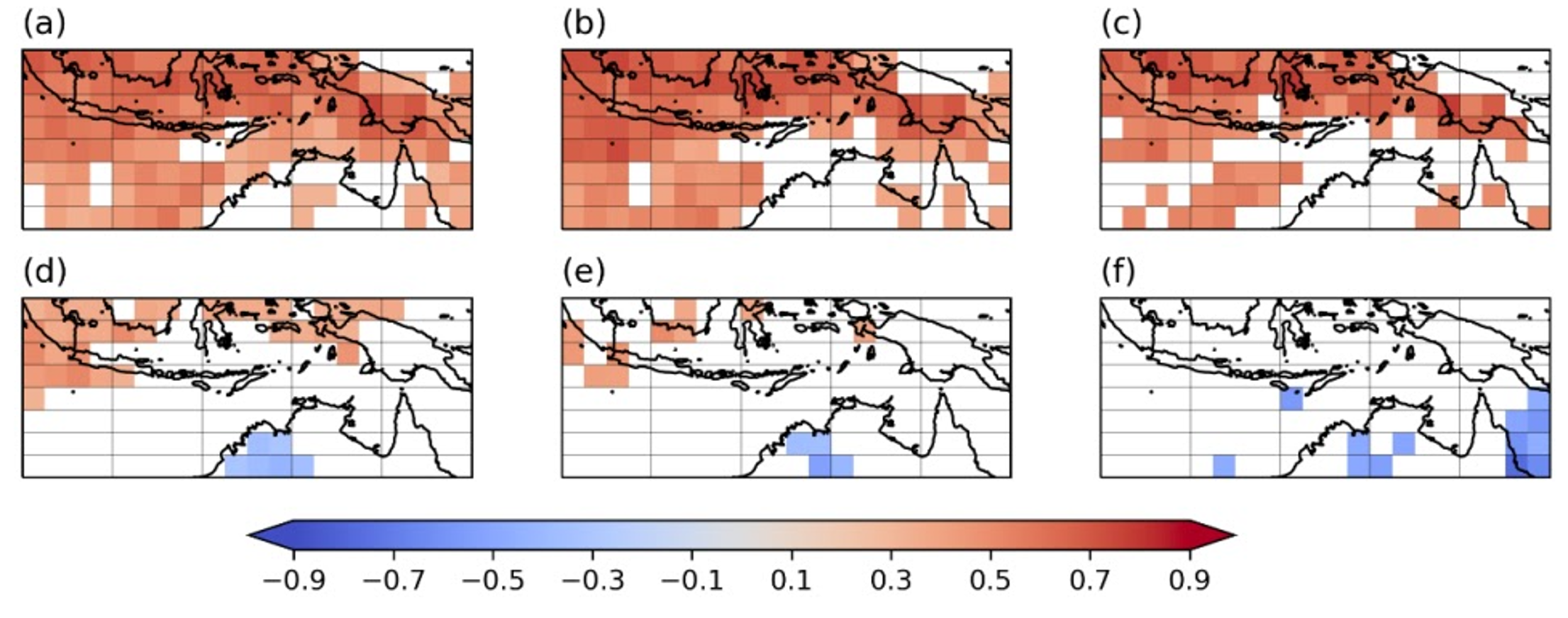
Figure 2.:ENSO’s and IOD’s teleconnections with the onset of summer monsoon over the Indonesia-Northern Australia (INA) region. Panels (a-c) show ENSO teleconnections: (a) long-term (1979-2018), (b) middle-term (1989-2018), and (c) short-term (1999-2018) patterns. Panels (d-f) show IOD teleconnections for the same time periods. Only statistically significant correlations (p < 0.05) are displayed, with positive correlations indicating delayed monsoon onset during positive phase events (El Niño/positive IOD) and negative correlations indicating early onset.
5.Discussion
In this study, monthly data are used, and OSM at each grid point is defined as the month when the precipitation reaches 15% of the total precipitation in the precipitation year. The GPCP dataset has daily precipitation data with a spatial resolution of 1° × 1°, which has higher applicability. Since the time availability of daily data is after 1996, only the short-term ENSO’s and IOD’s teleconnections with OSM can be analyzed. The results are basically consistent with the former results (not shown).
In addition, the definition of OSM in this study only involves precipitation as a variable, which reduces the representativeness of this definition to the actual onset of summer monsoon. It would be better for more variables to be considered, but in this study, this idea could not be effectively implemented because the OSM defined by the 850 hPa wind field and precipitation did not fall mostly in November February of the year. The use of simple definitions may weaken the credibility of the results.
In Section 4., analyses show that a persistent negative correlation between IOD phase and OSM in Northern Australia exists, which is similar to what Heidemann et al. (2023) found, that Australian monsoon rainfall from 1920 to 2021 has a weak negative correlation with the IOD phase over parts of Australia. Furthermore, the changes in IOD’s teleconnections in recent years can be a worthwhile signal, signifying that changes in the climate over the equatorial Indian Ocean and Maritime Continent have occurred. This result needs further validation and investigation.
- Supari, Tangang, F., Salimun, E., Aldrian, E., Sopaheluwakan, A., & Juneng, L. (2017). ENSO modulation of seasonal rainfall and extremes in Indonesia. Climate Dynamics, 51(7–8), 2559–2580. 10.1007/s00382-017-4028-8
- Abram, N. J., Henley, B. J., Sen Gupta, A., Lippmann, T. J. R., Clarke, H., Dowdy, A. J., Sharples, J. J., Nolan, R. H., Zhang, T., Wooster, M. J., Wurtzel, J. B., Meissner, K. J., Pitman, A. J., Ukkola, A. M., Murphy, B. P., Tapper, N. J., & Boer, M. M. (2021). Connections of climate change and variability to large and extreme forest fires in southeast Australia. Communications Earth & Environment, 2(1). 10.1038/s43247-020-00065-8
- Drosdowsky, W. (1996). Variability of the Australian Summer Monsoon at Darwin: 1957–1992. Journal of Climate, 9(1), 85–96. https://doi.org/10.1175/1520-0442(1996)009<;0085:votasm>2.0.co;2
- Zhang, H., & Moise, A. (2015). The Australian Summer Monsoon in Current and Future Climate. In The Monsoons and Climate Change (pp. 67–120). Springer International Publishing. 10.1007/978-3-319-21650-8_5
- Jourdain, N. C., Gupta, A. S., Taschetto, A. S., Ummenhofer, C. C., Moise, A. F., & Ashok, K. (2013). The Indo-Australian monsoon and its relationship to ENSO and IOD in reanalysis data and the CMIP3/CMIP5 simulations. Climate Dynamics, 41(11–12), 3073–3102. 10.1007/s00382-013-1676-1
- Kurniadi, A., Weller, E., Min, S., & Seong, M. (2021). Independent <scp>ENSO</scp> and <scp>IOD</scp> impacts on rainfall extremes over Indonesia. International Journal of Climatology, 41(6), 3640–3656. 10.1002/joc.7040
- Hung, C., & Yanai, M. (2004). Factors contributing to the onset of the Australian summer monsoon. Quarterly Journal of the Royal Meteorological Society, 130(597), 739–758. 10.1256/qj.02.191
- Lisonbee, J., Ribbe, J., & Wheeler, M. (2019). Defining the north Australian monsoon onset: A systematic review. Progress in Physical Geography: Earth and Environment, 44(3), 398–418. 10.1177/0309133319881107
- Duan, Y., Liu, H., Yu, W., Liu, L., Yang, G., & Liu, B. (2019). The Onset of the Indonesian–Australian Summer Monsoon Triggered by the First-Branch Eastward-Propagating Madden–Julian Oscillation. Journal of Climate, 32(17), 5453–5470. 10.1175/jcli-d-18-0513.1
- Tanaka, M. (1994). The Onset and Retreat Dates of the Austral Summer Monsoon over Indonesia, Australia and New Guinea. Journal of the Meteorological Society of Japan. Ser. II, 72(2), 255–267. 10.2151/jmsj1965.72.2_255
- Nicholls, N. (1984). A system for predicting the onset of the north Australian wet‐season. Journal of Climatology, 4(4), 425–435. 10.1002/joc.3370040407
- Heidemann, H., Cowan, T., Henley, B. J., Ribbe, J., Freund, M., & Power, S. (2023). Variability and long‐term change in Australian monsoon rainfall: A review. WIREs Climate Change, 14(3). 10.1002/wcc.823